
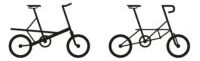

Was it a Moulton that overtook Boris Johnson on an evening in February 2006?
The other night a woman overtook me on her bike on the climb up to Islington. Nothing unusual about that, except that her wheels were only the size of soup plates. How was it possible that the revolutions of her tiny wheels could cover the ground more quickly than my huge wheels, when as far as I could see our feet were pumping up and down at the same sort of rate. I gazed at her retreating form with the baffled awe of a tribesman seeing his first aeroplane. Was it an optical illusion? Was it the gears? Not for the first time, I wished I understood physics properly. Is it true that a clock loses weight as the spring unwinds? Does a boat really go more quickly through cold water than hot water? The worrying thing is that the nation of Newton and Faraday is becoming almost as ignorant as me. Over the past ten years the number of students taking A-level physics has fallen from 45,000 to 30,000, and the number of university physics departments has fallen by a third. It is madness, not least since physics graduates are the best paid of all.
One week after the article was published in the Spectator, the letters to the editor contained the following:
Sir: I was surprised to read that Boris Johnson, as a cyclist and historian, had not pondered on what had allowed the reduction of wheel size from the ordinary 'penny-farthing' with the crank drive to that of the conventional bicycle which he no doubt rides (Diary, 11 February). It is, of course, the chain drive with the larger chainwheel at the crank and a smaller sprocket at the hub which enables the revolution of the cranks to be independent of wheel size. The Starley 'Safety' incorporated this. Lord Hailsham was probably the first parliamentarian to enjoy the benefits of the yet further reduction of wheel size with the Moulton bicycle.
He acquired this in 1964.
The letter was signed Alex Moulton.


